Table of Contents
What Is NLP?
Neuro-Linguistic Programming (NLP) is a model of human communication and personal change developed in California in the early 1970s by Richard Bandler and John Grinder. They studied the world's most effective communicators and therapists — including hypnotherapist Milton Erickson, family therapist Virginia Satir and Gestalt therapist Fritz Perls — and distilled the patterns behind their exceptional results into a learnable system.
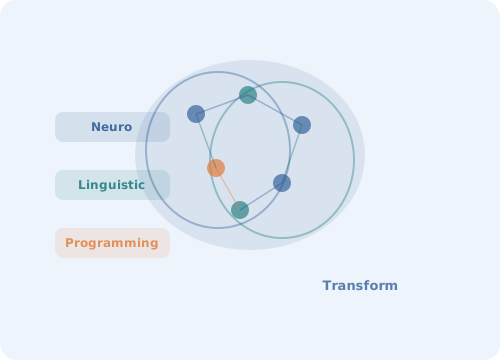
The three words describe the scope: Neuro — how your nervous system processes experience; Linguistic — how language shapes your perception of reality; Programming — the habitual patterns of thought, emotion and behaviour you run automatically.
NLP is now used globally in coaching, therapy, education, sales, leadership development and sports psychology. In Malaysia, it has been practiced since the early 2000s and has grown significantly in application across corporate and personal development contexts.
What Does “NLP Practitioner” Mean?
An NLP Practitioner is someone who has completed a recognised NLP training programme and has demonstrated basic competency in the core NLP techniques. Think of it as the foundational level of NLP certification — above this are NLP Master Practitioner, NLP Trainer and NLP Master Trainer.
A Licensed NLP Practitioner holds certification from the Society of NLP (the body co-founded by Richard Bandler) or another recognised NLP body. This distinction matters because NLP is unregulated — many “NLP certifications” are issued by organisations with no connection to the original methodology or meaningful quality standards.
What You Learn in an NLP Practitioner Course
A quality NLP Practitioner programme typically covers:
- The presuppositions of NLP — the foundational beliefs that underpin effective communication
- Rapport building — mirroring, matching and calibration to build deep connection quickly
- Representational systems — visual, auditory and kinaesthetic processing preferences
- Submodalities — the fine structure of internal representations and how to change them
- Anchoring — creating reliable access to desired emotional and performance states
- Reframing — changing the meaning of events to change their emotional impact
- The Meta Model — language patterns for gathering precise information and challenging limiting language
- The Milton Model — indirect, permissive hypnotic language patterns after Milton Erickson
- Strategies — understanding and modelling how people produce results
- Parts integration — resolving internal conflict
- Phobia cure — a rapid technique for resolving specific phobias
- Belief change — updating limiting beliefs at the subconscious level
How Malaysians Use NLP Practitioner Certification
NLP certification is relevant across a surprisingly wide range of professions and personal situations:
- Coaches and trainers using NLP to deliver deeper, faster results for clients
- Managers and HR professionals applying NLP to communication, performance and conflict resolution
- Sales professionals using NLP rapport and language patterns for ethical influence
- Teachers and educators applying NLP learning strategies for student engagement
- Healthcare workers using NLP for patient rapport and therapeutic support
- Parents applying NLP for family communication and supporting children's development
- Individuals seeking personal transformation, confidence or relief from specific fears
Why Training Lineage Matters More Than Price
NLP is an unregulated field. This means that the quality of NLP certification ranges from rigorous 7-day immersive programmes with genuine competency assessment to worthless online “certificates” issued after watching a few videos. The price alone tells you nothing about quality.
The most important question you can ask any NLP provider: “Who trained your trainer, and how far is the lineage from Richard Bandler?”
Training lineage matters because NLP is partly transmitted experientially — the nuances of the techniques are best learned from trainers who have themselves been taught at the highest level. NaviGo NLP Center in Kuala Lumpur offers the Licensed NLP Practitioner programme with one of the most direct lineages in Southeast Asia.
Cost of NLP Practitioner Certification in Malaysia
In Malaysia, reputable NLP Practitioner programmes typically range from RM 2,500 to RM 6,000 for a 7-day intensive. Shorter or online-only programmes at lower prices generally indicate lower quality training and certification that will not be recognised by serious employers or coaching clients.
HRD Corp funding may be available for employed Malaysians through their employers. Corporate organisations can apply for HRD Corp reimbursement for staff attending recognised NLP programmes.
How to Choose the Right NLP Course in Malaysia
Ask potential providers these questions before enrolling:
- Who trained your lead trainer, and what is their lineage from Bandler?
- Is the certification from the Society of NLP or another recognised body?
- How many training days are included? (Quality programmes are typically 7+ days)
- Is there a competency assessment before certification is issued?
- What post-certification support is provided?
Recommended: NaviGo NLP Center KL
NaviGo NLP Center offers Malaysia's most credentialled NLP Practitioner programme — a 7-day Licensed NLP Practitioner certification with direct lineage to the Society of NLP. View the programme details at navigonlp.com →